
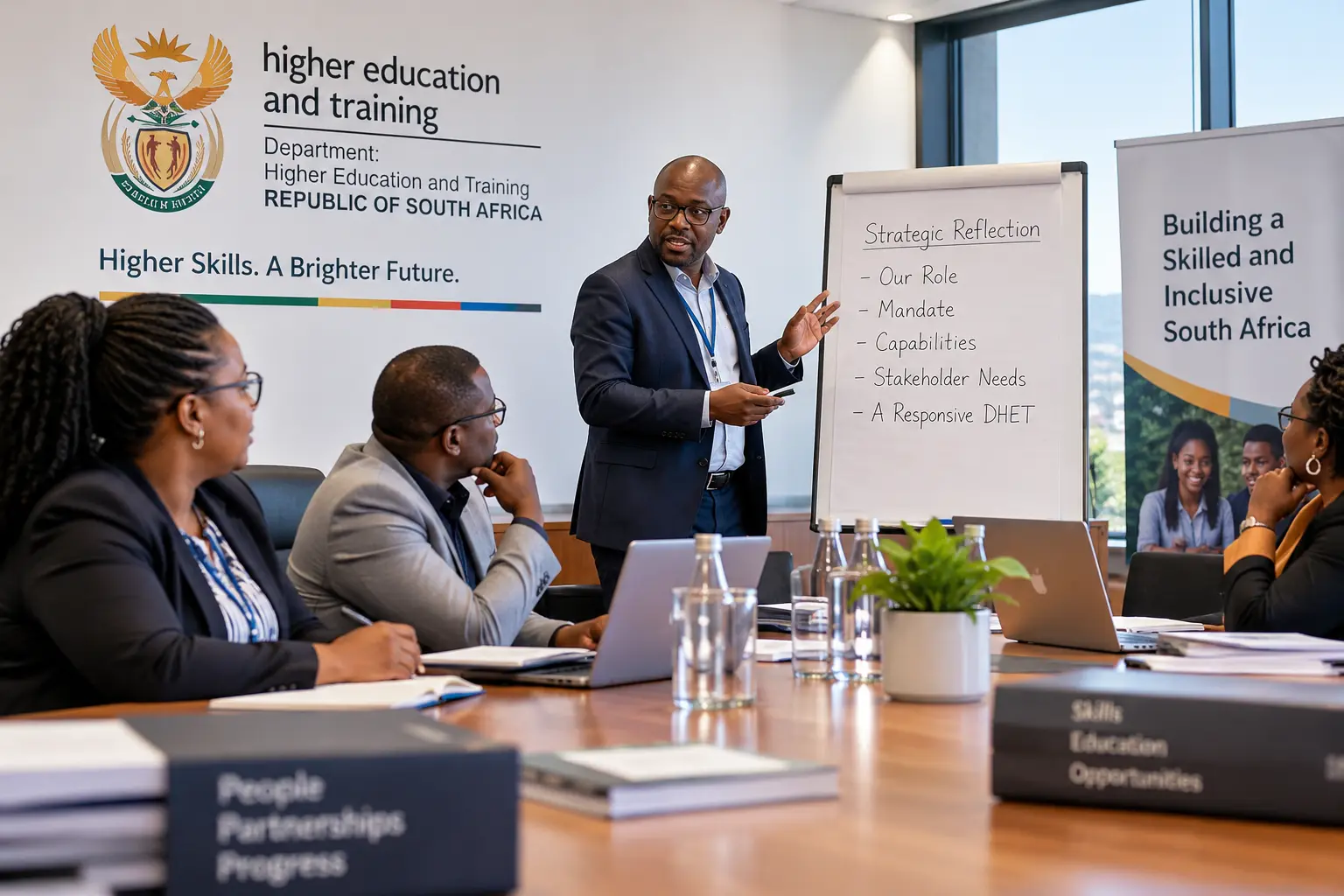
The Department of Higher Education and Training (DHET) is holding a two-day Strategic Reflection Workshop to rethink its role, mandate and institutional capacity during a period of evolving needs in higher education and training.
Representatives from across the sector will discuss whether the Department’s approach is suited to meet the needs of higher education and training institutions, and South Africa more broadly.
The emphasis should be on considering how the Department could become more responsive to the needs of the sector, as well as government.
Why DHET is holding the workshop
Higher education and training continues to evolve, placing changing expectations on universities, colleges, students, employers and government.
In particular, institutions are being challenged to be responsive to developments in skills development, access to education, graduate employability and shifting demands from the economy.
The strategic reflection offers an opportunity for the Department to scrutinise the relevance of its current mandate and institutional capabilities to meet changing expectations.
Not only are the current arrangements being analysed, but the Department is opening the debate on whether its role should change.
What will be discussed?
The two-day meetings will see participants discussing strategic questions around:
What value does DHET provide to higher education and training?
Is the Department’s current mandate still appropriate?
What institutional capabilities are required to effectively fulfil its responsibilities?
How can DHET be more responsive to stakeholders?
What possible changes are required as the sector evolves?
These discussions will allow the Department to identify areas where its role, capabilities or systems need to be adapted.
Government and sector stakeholders take part
The workshop includes representatives from various parts of the higher education and training landscape, including government, higher education institutions, sector organisations, and other key stakeholders.
Having these different perspectives in the same discussions allows the Department to take on board the expectations and experiences of organisations interacting with the Department and impacted by its decisions and policies.
Why stakeholder input matters
A ministry responsible for higher education and training operates within a complex system of universities, colleges, students, employers, and sector organisations.
The national level decisions taken by government departments – particularly at the higher education level – directly impact students, institutions, and the broader economy.
Engaging with stakeholders can enable the recognition of challenges between the objectives and expectations of policy, and the practical needs of organisations operating in the field.
Stakeholders can voice their expectations of the Department, and what they feel the Department should do differently.
Looking beyond the current mandate
One of the main focuses of the workshop is an examination of the relevance of DHET’s current mandate.
This does not necessarily mean that the Department is considering changing its mandate as a result of the discussions at the workshop.
Still, the conversations enable DHET to critically assess its responsibilities and understand if its current obligations need to be reconfigured to meet the needs of the sector and country.
Any changes will require further discussion at political level, and would follow appropriately mandated government processes.
Institutional capability also under review
As much as the focus of the workshop is on the Department’s mandate, institutional capabilities are also being discussed.
Having an appropriate mandate is just one aspect of good governance. For a department to perform according to its objectives it therefore requires systems, capability, staff and organisational structure to deliver results.
The Department wants to identify ways it can become more capable of performing its duties.
What could come next?
As much as one should not underestimate the importance of the strategic reflection, it should be seen as one part of a broader strategic engagement process.
The value of the meetings will ultimately be measured based on whether the issues raised are actually implemented as actions, priorities or improvements.
For those following developments in the higher education and training sector, the key developments to follow will be any recommendations or strategic changes emerging out of the strategic reflection.
Why the workshop matters for students and the public
While the strategic reflection is primarily about institutional responsibilities, its importance is extended to students, and the public at large.
DHET’s policies and institutional capacity impacts spheres associated with higher education and training, including universities, colleges and skills development.
Having a Department of Higher Education and Training that aligns its priorities with the sector can have positive implications for how institutions respond to sector challenges, and how students receive support.
That said, the workshop itself is not an indication that changes have been made or agreed on.
A strategic look at the future of DHET
The two-day Strategic Reflection Workshop will give DHET and its stakeholders the opportunity to critically evaluate the effectiveness of the Department’s operations, and rethink its role in the context of a shifting higher education and training environment.
By examining its mandate, institutional capabilities and stakeholder expectations, the Department is opening up a broader debate on its trajectory.
Ahead lies the most important work of implementing those strategic conversations, to translate them into practical actions to strengthen the higher education and training system.
Source and reporting note
This article was independently written from information supplied about the DHET strategic reflection workshop and its objectives.
The article does not present potential future changes as decisions that have already been made.
Editorial policy
We provide independently written reporting and explainers about South Africa’s higher education, training and skills-development sector.
We distinguish between confirmed announcements, stated objectives and potential future developments.
Disclaimer
This article is for general information and public awareness. It is not an official statement from the Department of Higher Education and Training. Readers should rely on official DHET announcements for confirmation of any future policy, mandate, institutional or programme changes.
