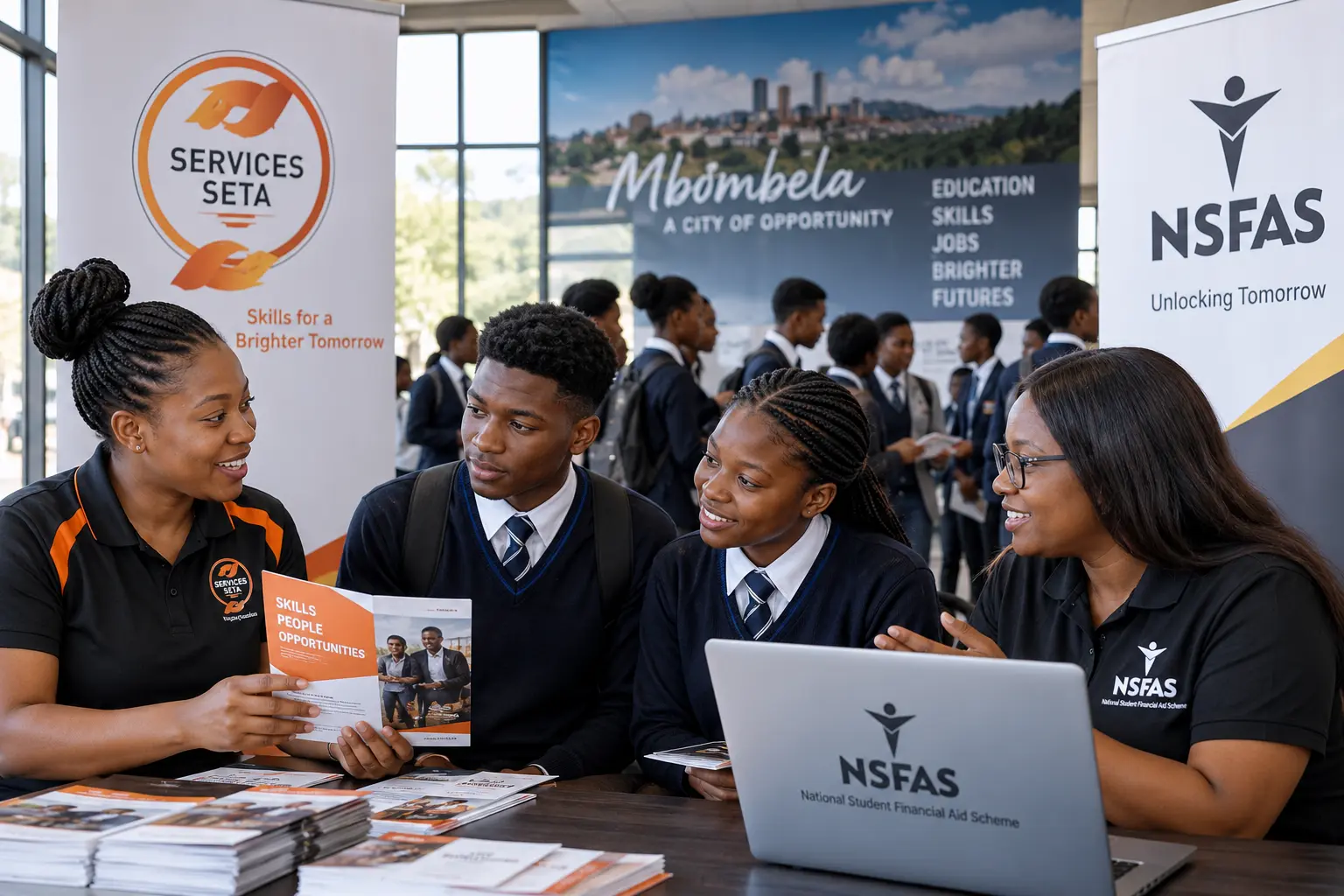
Grade 11 and 12 learners in Mbombela received information about NSFAS funding, post-school education and occupational skills when Services SETA and the National Student Financial Aid Scheme (NSFAS) engaged learners at Lihawu Secondary School and E.J. Singwana Secondary School on 4 September 2026.
Learners were able to ask questions about the NSFAS funding process, post-school opportunities and occupational skills.
A highlight of the engagement was the focus on the role of accurate information in the application process.
Learners also received guidance about what to look for in a job offer and a variety of opportunities into the world of work.
Learners Forewarned About NSFAS Fraud
NSFAS Risk Specialist Vuyani Daweti took part in the engagement to provide learners with his experience with fraudulent application practices.
At the same time, learners were advised to keep their credentials private unless they deal with an official NSFAS representative.
Daweti pointed out the need for learners who apply for NSFAS funding to take ownership of the information they give to the scheme.
The problem of NSFAS fraud is especially pertinent for matric learners who apply for financial aid.
By calling learners’ attention to the risks of fraud, Daweti was able to reinforce the message that they must protect their own information and not fall for offers made by people who claim they can get them funding in exchange for a commission.
Former and Current NSFAS Beneficiaries Share Their Experiences
The engagement also allowed learners to ask questions of former and current beneficiaries.
Lulama Sithole, a student at Tshwane University of Technology (TUT), and Noxolo Masinga, an LLB graduate, were among those who shared their journeys as students and as NSFAS beneficiaries.
Their presence at the engagement added a personal touch to the information provided by the NSFAS and Services SETA representatives.
The beneficiaries urged learners to take their studies seriously and to keep up with their studies in order to be eligible for NSFAS funding.
Services SETA Encourages Learners to Develop Occupational Skills
Services SETA’s George Matlala encouraged learners to focus on occupational skills.
“It’s not about where you come from, it is about where you are going,” he said.
Learners were also informed that there are a number of ways in which someone can get into the world of work, depending on their interests and needs.
Matlala’s message was that learners should not limit themselves to one area of study or work.
Instead, they should see the post-school environment as a spectrum of opportunities, depending on their own preferences and requirements.
TVET Colleges Also Discussed
Learners were also encouraged to think about TVET colleges and occupational skills when choosing their post-school path.
Although some learners will choose to do degrees at universities, there are other options for people who prefer practical and occupational skills-based studies.
TVET colleges can be a viable alternative to universities for learners who are interested in technical, vocational and occupational studies and training.
The engagement therefore encouraged learners to think about their interests and abilities before they make a decision about their post-school studies.
Grade 11 and 12 Learners: Why Guidance About Funding and Career Options Matters
The final years of secondary education are the period when most learners will need to make decisions about their post-school options.
Receiving information about funding processes early enough means that learners will have sufficient time to look into the necessary documentation and admission requirements for their preferred areas of study.
For learners who will need financial aid to fund their studies, understanding NSFAS procedures and the risks of fraud could be as important as knowing what degree or diploma they want to do after school.
Guidance about career options is also needed because many learners believe that a degree is their only post-school option when, in fact, there are a number of other possibilities – such as doing an apprenticeship or studying a technical or occupational skills-based course.
What the Post-School Engagement in Mbombela Means for Grade 11 and 12 Learners
The Mbombela engagements touched on a number of matters that Grade 11 and 12 learners need to consider as they near the end of their school careers.
They include understanding the NSFAS processes, knowing which area of study they want to pursue, finding out about the different kinds of post-school institutions, such as TVET colleges, and understanding the risks of fraud.
By engaging current and former NSFAS beneficiaries, the learners also had the opportunity to learn more about what it is like to go through the process of applying for financial aid and to ask questions about the experience.
The Grade 11 engagement gives these learners the opportunity to prepare themselves for the final year of school and the post-school path they want to take.
For Grade 12 learners, the engagement came at a convenient time since they will soon be leaving school and starting to make preparations for post-school studies.
Grade 11 and 12 Learners Advised to Prepare Themselves for Post-School Path
The information and experiences shared during the engagement at Lihawu Secondary School and E.J. Singwana Secondary School is relevant to all learners who want to make informed decisions about their life after school.
The message from Services SETA and NSFAS was that learners do not only need to apply for NSFAS funding, but also that they should make informed decisions about their studies and about their application for financial aid.
They should protect themselves from fraud by not disclosing personal information to unscrupulous individuals and by ensuring that they deal only with official NSFAS and education department representatives.
Learners also need to think about their future studies not only in terms of the qualification they want to do, but also in terms of the environment they want to study in.
This means that they need to think about TVET colleges as an option, as well as the kinds of skills that would suit them best.
For young people who are at the point in life where they need to make decisions about their future, access to information is empowering.
It enables them to make decisions according to their own needs and not according to the expectations of others.
Source and reporting note
This article was independently written from information supplied about the Services SETA and NSFAS learner engagements held in Mbombela on 4 September 2026.
The information contained in the article is reported as given by the participants in the engagement.
Editorial policy
We provide independently written reporting and practical information about education, student funding, skills development, learnerships and post-school opportunities in South Africa.
We distinguish between confirmed information, advice given during engagements and future opportunities that may have to be applied for separately.
Disclaimer
This article is for general information and public awareness and is not an official NSFAS funding application notice or a guarantee of funding.
Learners should use official NSFAS and institutional channels when applying for financial aid and should never pay an individual who claims they can guarantee funding.
